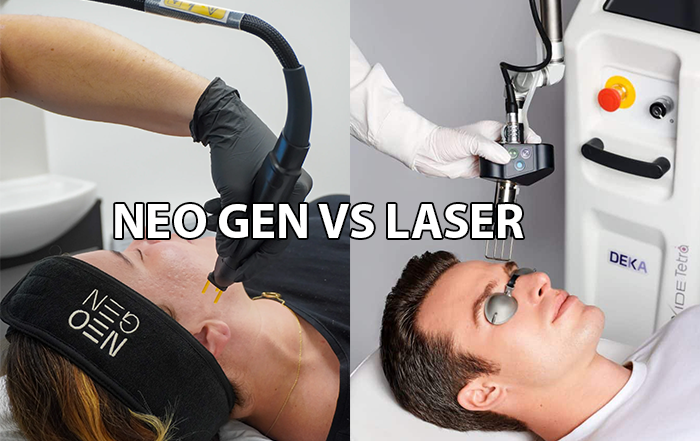
Skin tightening is one of the most crowded categories in aesthetics. Fractional lasers, radiofrequency (RF) microneedling, ultrasound devices, and nitrogen plasma systems like Neogen all promise firmer, smoother skin, and from the outside they can sound almost identical. For a practice deciding what to add to its menu, the useful question isn’t “which one is best?” but “which one solves the problem my patients actually bring me?” Here is a practical framework for comparing them.
The same goal, different energy sources
All of these technologies aim to stimulate the skin’s own collagen and elastin production, and the biggest difference between them is how they deliver energy. Lasers use focused light, RF microneedling delivers radiofrequency energy through fine needles, and Neogen uses ionized nitrogen gas, a technology known as Plasma Skin Regeneration (PSR), to deliver controlled thermal energy into the dermis. We explain the mechanism in more detail in our guide to what Neogen is and in Neogen PSR explained.
Factor 1: Downtime and the patient experience
Downtime is often what decides whether a patient actually books. Resurfacing lasers vary widely, from gentle non-ablative settings to more aggressive treatments with a longer recovery. Neogen is designed to work with the skin’s surface rather than remove it, so recovery tends to be shorter than fully ablative resurfacing, with some redness afterward being normal. When comparing devices, ask each vendor what a typical patient experiences in the first week, and how that changes with the settings used for tightening.
Factor 2: Skin type range
Not every technology is equally suited to every patient. Some resurfacing approaches carry more risk for medium and darker skin tones, which narrows the number of patients a practice can treat comfortably. Neogen is validated for skin types I–IV, which makes it accessible to a broader group of patients. Whatever device you evaluate, ask for the exact Fitzpatrick range it is validated for, and for the supporting documentation.
Factor 3: What concern it is built for
Different tools shine at different concerns. Some are primarily positioned around surface texture and pigmentation, while others focus on deeper tightening. Neogen targets the deeper dermal structure to support firmness, texture, and overall skin density. It is also frequently recommended for facial volume changes after rapid weight loss, a topic we cover in our article on Neogen and GLP-1 facial volume loss. Start with your patients’ top three concerns and match the technology to those, rather than to the broadest list of claims.
Factor 4: Treatment timeline and expectations
Skin tightening technologies that work by stimulating collagen all share a similar timeline: results build gradually as new collagen matures. With Neogen, visible improvement is often seen around the three-month mark, with continued enhancement over time. Setting that expectation up front matters more than any device specification, because patients who expect instant results are the ones most likely to be disappointed with any of these technologies.
Factor 5: Practice economics
For the practice, the comparison also comes down to numbers. Look at the device investment, per-treatment consumable costs, treatment time per patient, the price you can reasonably charge in your market, and how many treatments a typical protocol requires. A device with a higher upfront cost can still be the better business decision if it opens a treatment category your practice doesn’t offer yet, or if it serves patients you currently refer elsewhere.
Competing or complementary?
In many practices these technologies don’t compete so much as stack. A patient who has already tried lighter resurfacing or topical treatments may be looking for a more substantial improvement without surgery, which is where a deeper-acting technology fits. Others combine tightening treatments with microneedling such as Dermapen 4 and a supportive at-home routine. The right combination depends on the patient’s goals and treatment history, and is a decision for the treating provider.
Questions to ask before choosing any skin tightening device
- Which skin types is it validated for, and what documentation supports that?
- What does recovery typically look like, and how does it change with settings?
- How many sessions does a typical protocol require, and over what timeline?
- What are the per-treatment costs beyond the device itself?
- What training, protocols, and ongoing support are included?
- What claims can I appropriately make to patients about results?
Where to go next
If you are comparing options for your practice, you can review the full details on the Neogen page, or contact our team to talk through protocols, training, and pricing, and to see how Neogen would fit alongside the technologies you already offer.