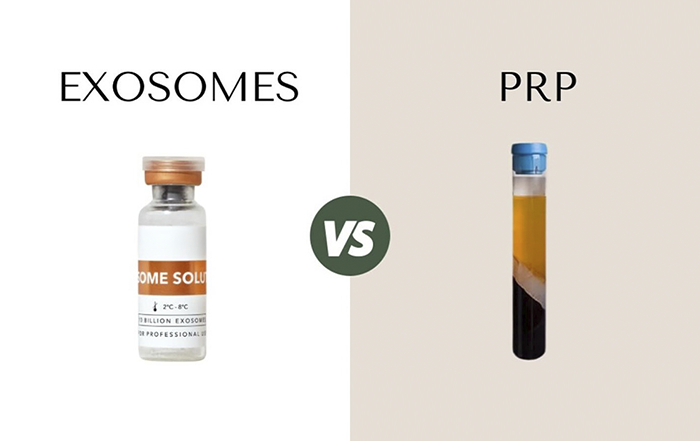
Few questions come up more often in regenerative aesthetics right now than “should I offer PRP or exosomes?” The honest answer is that they’re two different tools, often confused because both are associated with skin renewal. Understanding what each one actually is makes it much easier to explain to patients, and to decide how they fit into your treatment menu.
What is PRP?
PRP (platelet-rich plasma) is an autologous treatment, meaning it’s made from the patient’s own blood. A small blood draw is spun in a centrifuge to concentrate the platelets, and the resulting plasma is then applied or injected as part of a regenerative protocol. Because it comes from the patient, PRP is a procedure performed in the treatment room, and the quality of the result depends heavily on the system used to prepare it. Metrics such as platelet recovery, red blood cell removal, and final platelet concentration are worth asking about with any kit. You can see how those compare across systems in our guide to PurePRP Two and AbsolutePRP Gold.
What are exosomes?
Exosomes are tiny signaling particles that cells release to communicate with each other. In skincare and hair care, exosome-based products are formulated to support the appearance of skin and the condition of the scalp through topical use. They are generally positioned as cosmetic products rather than in-office blood procedures, which makes them easy to send home with a patient. A product like EXO-SKIN Exosome Serum fits that profile: a take-home step that supports what was done in the treatment room.
The key differences at a glance
Source: PRP is made from the patient’s own blood at the time of treatment. Exosome products are manufactured, packaged products.
Where it happens: PRP is performed in the practice by a trained provider. Topical exosome products can be used in-office after a procedure and continued at home.
Role in the protocol: PRP is typically a treatment event, often delivered in a series. Exosome products usually work as a supporting step before, after, or between appointments.
Practice economics: PRP generates treatment revenue and requires a kit and a centrifuge workflow. Exosome products add retail revenue and recurring refills with no additional equipment.
Why they work well together instead of competing
Practices that get the most out of both rarely treat them as an either/or choice. A common pattern is to use PRP as the in-office treatment, frequently paired with microneedling with Dermapen 4, and then send the patient home with an exosome serum and a hydrating step such as MG-HA35. The treatment creates the reason for the visit, and the at-home routine keeps the patient engaged between sessions.
The hair side of the conversation
The same logic applies to hair. Many practices offer PRP-based scalp protocols, and an exosome-based hair line like ExoGrow gives those patients something to use daily between appointments. That pairing lets you address the same concern, thinning or hair condition, from two angles: in-office treatment and consistent home care.
How to explain it to patients without overpromising
Patients are often arriving with strong opinions from social media, so clear and honest language matters. Describe PRP as a treatment prepared from their own blood and delivered by a provider, and describe exosome products as topical products that support the appearance of skin or hair. Avoid promising specific medical outcomes, set expectations about timelines (results from regenerative protocols build over weeks and months), and remind patients that outcomes vary from person to person.
Questions to ask before adding either to your menu
For PRP, ask about platelet recovery and concentration data, available draw volumes, processing time per patient, and training. For exosome products, ask how the product is classified, what claims are appropriate to make, and what ingredient and documentation information is available. The practices that do this homework tend to build more credible, more repeatable protocols than the ones that adopt a trend without the background.
Where to go next
If you’re building or expanding a regenerative menu, you can explore our full PRP collection and exosome collection, or contact our team to talk through a combined protocol that fits your practice, your patients, and your treatment room.