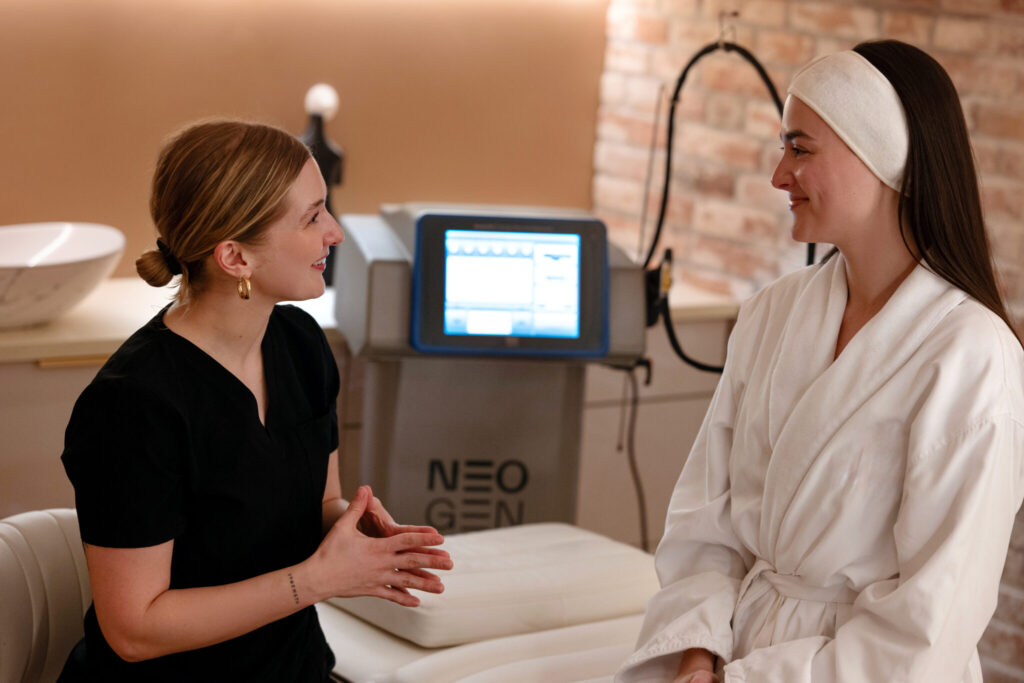
The rapid rise of GLP-1 medications has created a patient population medspas didn’t have to plan for five years ago: people who have lost significant weight quickly, and whose faces are showing it. Sunken cheeks, looser skin, and a hollowed appearance — often nicknamed “Ozempic face” — have turned into one of the most common reasons patients are walking into consultations. Neogen has emerged as one of the more effective non-surgical answers to this specific problem.
Why rapid weight loss changes the face differently
Facial fat pads provide structural support, and when they shrink quickly, the skin covering them doesn’t always have time to adapt. The result isn’t just volume loss — it’s a combination of volume loss and reduced skin elasticity, which is why filler alone often isn’t the full answer. Patients need something that also improves the skin’s ability to hold its new shape.
This is where Neogen’s mechanism becomes relevant. By stimulating collagen and elastin remodeling in the dermis, it doesn’t add volume the way a filler does — instead, it helps the skin itself tighten and thicken, improving the appearance of volume loss from the inside rather than propping it up from the outside.
What practices are reporting
Alongside its broader skin regeneration benefits, Neogen is specifically noted for improving the appearance of facial volume after GLP-1 use. For medspas, this reframes the conversation with a fast-growing group of patients: instead of only offering filler (which addresses volume but not skin quality), Neogen offers a complementary — and in some cases standalone — path that treats the underlying skin structure.
Practices that have started screening new consultations for GLP-1 use are finding a natural intake question: “Have you lost weight quickly in the past year?” That single question is opening conversations that lead directly into a Neogen treatment plan, often as a series rather than a one-time visit, given the three-month-plus timeline for visible results.
Positioning Neogen for this patient group
The patients arriving with GLP-1-related concerns tend to be more informed than average — many have already researched “Ozempic face” solutions online before their consultation. That means the marketing and education opportunity is real: practices that publish content, host information sessions, or simply train front-desk staff to recognize and speak to this concern tend to convert these consultations more efficiently.
It’s also worth pairing Neogen with a clear explanation of timeline expectations. Patients coming from a weight-loss journey are often used to visible, relatively fast changes on the scale, so setting expectations around the three-month collagen remodeling window up front avoids disappointment and supports better treatment adherence.
Building a GLP-1 protocol that patients actually follow
Beyond the intake question, some practices are building a short pre-treatment consult specifically for this group — reviewing how long ago the weight loss occurred, whether it’s ongoing, and whether the patient is also a candidate for combined treatments. Patients who are still actively losing weight are often better served waiting until their weight stabilizes before starting a full Neogen course, since skin structure is still adjusting. Practices that build this check into their intake process tend to see stronger, more predictable results and fewer patients returning disappointed mid-protocol.
The bigger picture
GLP-1 medications aren’t a passing trend — the patient population dealing with facial volume loss as a result is only going to grow. Practices that build a clear, repeatable protocol now, with Neogen as a core tool, are positioning themselves to capture a segment of demand that many competitors are still treating as a filler-only problem. To see full specifications or discuss how Neogen could fit your GLP-1 patient flow, visit the Neogen page or reach out to our team directly.