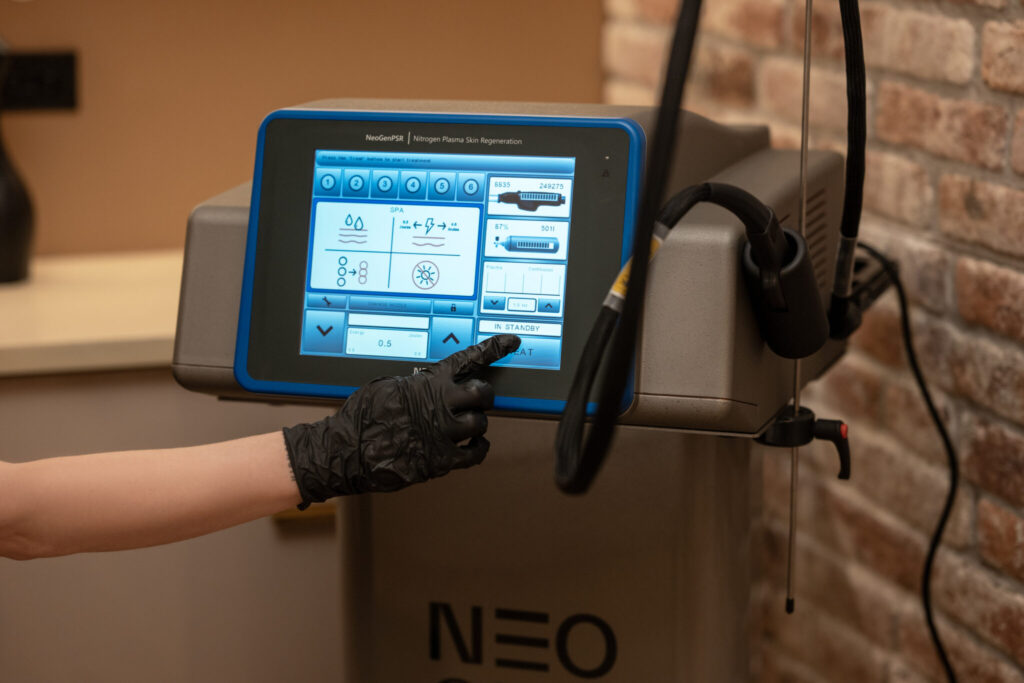
For years, patients chasing firmer, more youthful skin faced a trade-off: aggressive ablative resurfacing with real downtime, or gentler treatments that delivered modest, slow-fading results. Nitrogen plasma technology changes that equation, and Neogen has become one of the clearest examples of what this category can do.
What nitrogen plasma actually does
Neogen uses controlled nitrogen plasma energy to deliver thermal energy deep into the dermis — the layer where collagen and elastin are produced — while leaving the skin’s surface largely intact. Because the epidermis isn’t stripped away the way it is with fully ablative lasers, patients experience far less visible downtime, while the deeper layers still receive enough stimulation to trigger genuine tissue remodeling.
This is the core appeal for medspas: a treatment that behaves like a resurfacing procedure in terms of results, but recovers more like a surface-level treatment in terms of patient experience.
The results practices are seeing
Clinical data behind Neogen shows increases in skin density of up to 80%, along with visible improvements in firmness, texture, and the fine lines and looseness associated with aging. Because collagen remodeling is a biological process, results aren’t instant — most patients start noticing meaningful change around the three-month mark, with continued improvement over the following months as new collagen matures.
That progressive timeline is actually a selling point for practices: it supports a natural conversation about follow-up visits, maintenance sessions, and combination protocols, rather than a single one-and-done transaction.
Why this matters for your treatment menu
Skin types I–IV can be treated with Neogen, which widens the pool of candidates compared to some resurfacing technologies that carry higher risk for medium-to-darker skin tones. For a medspa or dermatology practice, that translates directly into a broader addressable patient base without adding a second device line just to cover more skin types.
Practices are also using Neogen as an entry point into more advanced skin-quality conversations — positioning it not just as a wrinkle treatment, but as a way to address overall skin structure, something that resonates with patients who have already tried topical retinoids or lighter peels and want a more substantial result.
Where Neogen fits in a treatment protocol
Because it targets the dermis rather than surface pigment or vascularity, Neogen pairs naturally with treatments that address different layers or concerns — for example, surface-level resurfacing for texture, or a body contouring system like T-Shape 2 for patients working on overall rejuvenation rather than a single area. The device itself is designed to slot into an existing treatment room without requiring a dedicated build-out, which shortens the time between purchase and revenue.
For practices evaluating their next equipment investment, the questions worth asking are less about the technology in isolation and more about fit: What percentage of your current patients are asking about firmness and texture rather than just wrinkles? How many are already GLP-1 patients dealing with volume loss? And how does a three-month results timeline align with your existing follow-up and retention model?
Adding Neogen to your practice
Practices that succeed with nitrogen plasma treatments tend to be the ones that set the three-month expectation clearly at consultation and build a simple maintenance protocol around it, rather than treating Neogen as a single-visit service. If you want to see how the device fits into your treatment room and current patient flow, take a look at the full Neogen specifications, or get in touch with our team to talk through pricing, training, and onboarding for your practice.